
Златна Панега / Golden Panega
- #documentary
- #river
- #wildlife
Some places feel like a fairytale even before you know their stories. The valley of the Zlatna Panega, the "Golden Panega" river in north-western Bulgaria, is one of them. 🌲
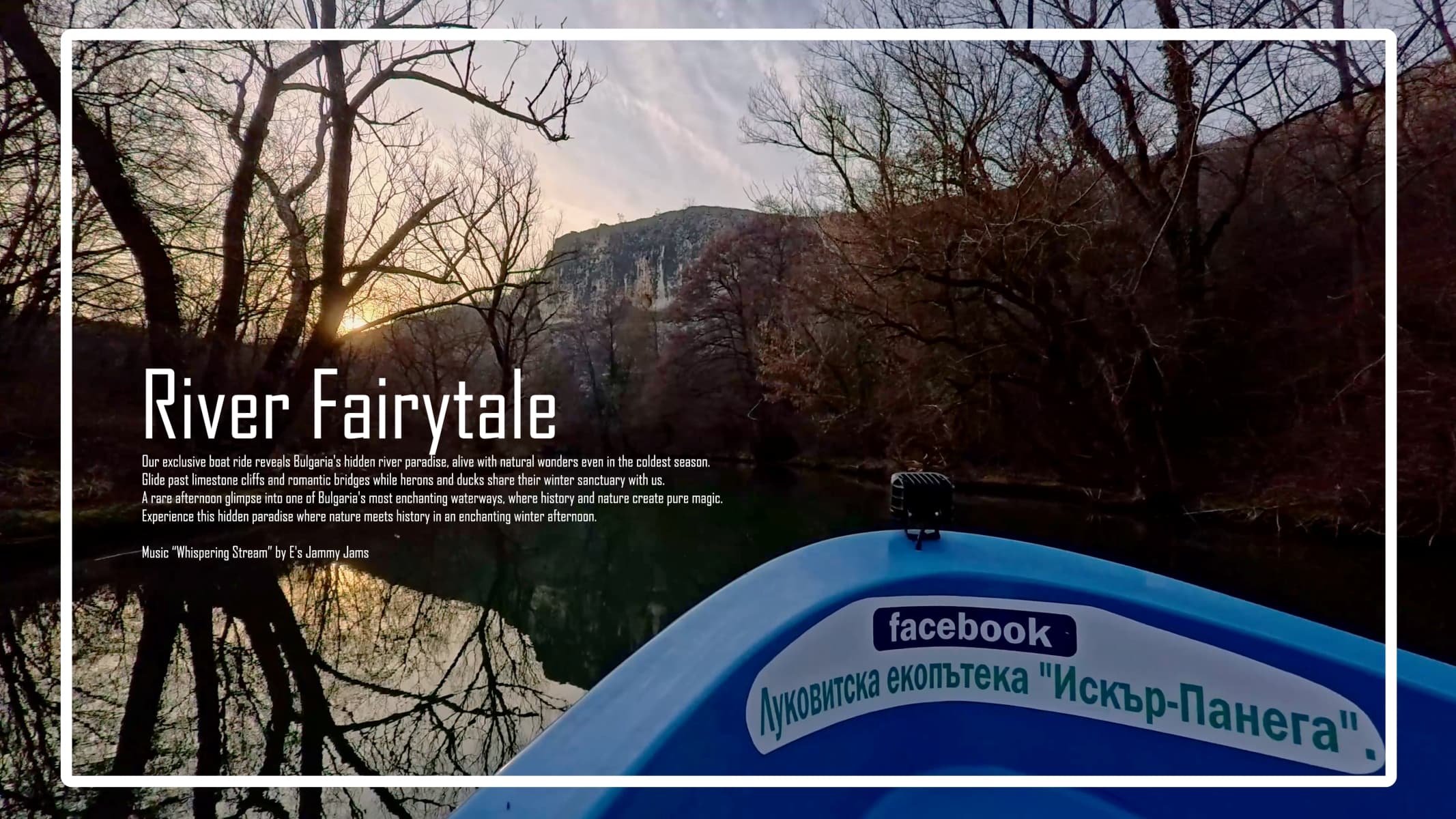
I went there in winter with my camera, followed the river, its banks and its birds, and came back with a short film I called River Fairytale. This post is the story behind it, along with the history, landmarks and legends that make this quiet corner of Bulgaria so special.
💧 The spring: Glava Panega
The river is born at Glava Panega ("the Head of Panega"), a karst spring near the village of Zlatna Panega. It is one of the largest karst springs in Bulgaria, second only to the Devnya springs, pushing out around 2.5 cubic metres of water every second.
The water rises into two small lakes, separated by the road to Brestnitsa. Dissolved calcium carbonate gives them a pale blue-green colour, which earned them the local nickname "the Blue Ink Springs". 💙 The water stays cold all year, roughly 8–15 °C, with a few small warm springs nearby at around 20 °C.
For a long time nobody knew exactly where all this water came from. Studies in the 20th century showed that most of it is the Vit River, disappearing underground and travelling through the karst before surfacing here. Two small caves by the western lake hint that the spring once flowed out of the rock itself. The springs have been a protected natural landmark since 1966.
From here the Zlatna Panega flows about 50 km north through the Fore-Balkan, carving a scenic gorge near Lukovit, before joining the Iskar and, through it, the Danube.
🏛️ History and landmarks
People have gathered around this water for thousands of years.
- The sanctuary of Asclepius. In Thracian and Roman times a sanctuary of Asclepius, the god of healing, stood by the spring. Excavations between 1903 and 1906 uncovered it, and a stone relief found on a promontory above the upper spring shows Asclepius with his children Hygieia and Telesphorus.
- Temnata Dupka. The "Dark Hole" cave in the Zlatna Panega canyon holds traces of early modern humans, Homo sapiens.
- The Lukovit Treasure. In 1954 a Thracian silver treasure of around 200 pieces from the 4th century BC was found near Lukovit. The original is in the National Archaeological Museum in Sofia.
- Iskar-Panega Geopark. Near Lukovit, eco trails with wooden bridges and handrails lead through rock formations 100–120 million years old, and to Staritsata, the oldest and most picturesque meander of the river.
- A land of caves. The three municipalities along the valley, Yablanitsa, Lukovit and Cherven Bryag, hold over 700 caves. They include Prohodna, "the Eyes of God", on the nearby Iskar.
Today the river also powers a few small hydro plants and supplies the cement works that gave the village its industrial side. Nature and history sit side by side, just a few kilometres apart. 🪨
📜 Stories and myths
The name of a goddess. Local tradition says the river takes its name from the family of Asclepius: from Panacea (Panaka), his daughter and the goddess of universal remedy. Over the centuries, Panaka became Panega, and the "Golden" was added later. A healing river named after the goddess of cures, with a temple of the god of medicine at its source: the story fits the place perfectly. ✨
Healing waters. For centuries people believed that Asclepius himself was present at the spring, helping the sick who bathed in or drank its water. Pilgrims travelled long distances for a cure. The tradition hasn't entirely disappeared: visitors still throw coins into the blue water as an offering. 🪙
The shepherd's golden staff. One legend tells of a shepherd who hid his gold inside his wooden staff. One day the staff fell into a mountain lake and vanished. Some time later he found it again, floating in the spring at Glava Panega, carried there by the water through the depths of the earth. Like many legends, it hides a truth: the spring really is fed by water that disappears underground far away and resurfaces here.
👣 My story
On a sunny 26 January 2025, we decided to explore the Zlatna Panega eco trail in winter. I had visited the park long ago, but this time was different. ☀️
At the trail we found boats for hire and a motorboat tour, and in the middle of winter there was hardly anyone around. In fact, we were the only ones on the water. With a boat all to ourselves, we saw the Zlatna Panega from a completely different angle, and we went much deeper than the trail itself, all the way up to the lake below Lukovit's park. 🚤
Soon after setting off, we had settled into the boat. The engine murmured smoothly, and there was no hurry and no pressure. 🛥️ One by one we glided under the simple but beautiful bridges of the eco trail, each with its own name, which I talk about in the video:
- The Bridge of Luck (Мост на късмета) 🍀
- The Bridge of Happiness (Мост на щастието) 😊
- The Bridge of the Smile (Мост на усмивката) 😃
- The Bridge of Love (Мост на влюбените) ❤️
- The Bridge of the Kiss (Мост на целувката) 💋
- The Nameless Bridge (Мост без име) ❓
With no other boats on the water, I could capture the valley untouched: shining cliffs, still water, and many wild birds that, for some reason, had stayed for the winter, ducks, herons and more. 🦆
With the trees bare of leaves, the karst landscape lay wide open to us: an amazing composition of holes and caves, and magnificent tall cliffs stretching high above the boat. 🪨 In summer those cliffs are home to nesting birds. In winter they stood silent, waiting.
Along the banks we met a few other walkers and some dedicated fishermen trying their luck. 🎣 We even pulled over to chat with them. Our captain and guide knew several of them, which made the stops feel more like meeting neighbours than strangers.
Just before we reached the lake near Lukovit, we came across a large flock of birds relaxing in the gentle sun. 🐦 They hopped as a group from one spot to the next, playing and preening their feathers, completely at ease with our quiet boat.
Winter days are short, and as the afternoon went on we watched the sun go down for its night's sleep. 🌅 The sunset painted the water with reflections of the sky, the cliffs and the bare trees, a perfect ending to the day.
The day was warm, calm and sunny, unusually so for January. It was the perfect match for enjoying nature, sightseeing and filming. That's how River Fairytale was born.
🎬 Watch the video
The valley in winter, its river, its birds and its riverside trails: River Fairytale on YouTube. 🎥
If you go: the springs are just off the road from the village of Zlatna Panega towards Brestnitsa. You can drive almost to the lakes, and a short footpath leads from the parking area. For longer walks, head to the eco trails of the Iskar-Panega Geopark near Lukovit.
Sources: Zlatna Panega (river) – Wikipedia · Visit Bulgaria – Zlatna Panega karst springs · Lukovit Municipality – History · BNR – Eco trip along the Zlatna Panega valley